Monday, June 05, 2006

Live the moment


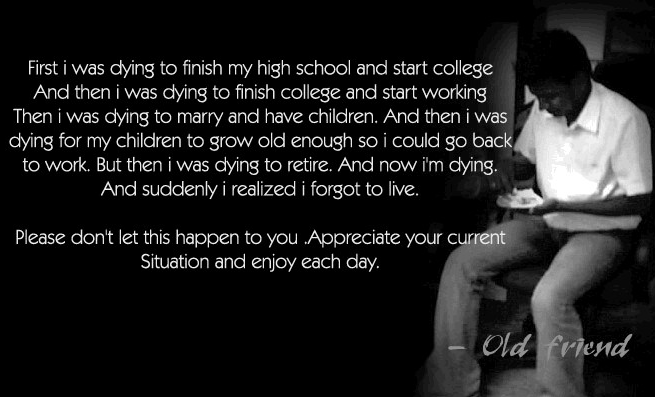
I have been having this image on my desktop because the moment I read it, it touched a very deep vein. And I realized that if this moment is not enjoyed we are never going to be happy, ever!


I remember a piece of advice that my father gave me long time back while I was back in school. He told me, that I should live my life in a way such that anytime you stop and look back, you should not have any regrets for things you have done and things you have not done. I never really understood the true meaning of this until I saw the above.

I was browsing Steve Pavlina's blog after a long time today and here it was, a post where he talks about living the present moment, called The Power of Now. Well is it a synchrocity or not I don't know, but it sure is a sign that is telling me that I should concentrate more on enjoying the present moment.

The way I see it enjoying the present moment has a lot to do with being contend with what you have. Either you are happy with what you are and have or you learn to be happy. My religious teaching tells me to find happiness with what is already there. And I never realized that it did not mean that we should not be ambitious, but rather it tells us to enjoy the present moment and not to leave living your life until your ambitions are achieved.

Reading Steve's post opned my eyes a bit more. That is why I thought of sharing the news through this hoping it will help more people. When you hear the good news, you should share it!

Friday, June 02, 2006

Presentation Tips

This is a very useful resource for anyone who will be making presentations as part of their work or education courses.

Whilst most of the tips can be attributed to common sense, it does give some points that you will not think of. It is a simple presentation in itself which is very easy to retain. I hate tips that run for pages. I think tips which are longer than a few short points defy the purpose. You are not reading the tips to remember a long list of tips. You are likely to pickup a few that will stick with you or appeal to you. In that sense this is a very good reading…

The Craig Web Experience: Presentation Tips

Wednesday, April 19, 2006

The power of conditioning

I got this story on an email today. If this is true, it is the power of conditioning. Something that we need to break free from. It is interesting to read, and even more interesting to think long and hard about…

As I was passing the elephants, I suddenly stopped, confused by the fact
that these huge creatures were being held by only a small rope tied to their
front leg. No chains, no cages. It was obvious that the elephants could, at
anytime, break away from their bonds but for some reason, they did not.

I saw a trainer near by and asked why these beautiful, magnificent
animals just stood there and made no attempt to get away. "Well," he said, "when
they are very young and much smaller we use the same size rope to tie them and,
at that age, it's enough to hold them. As they grow up, they are conditioned to
believe they cannot break away. They believe the rope can still hold them, so
they never try to break free." I was amazed. These animals could at any time
break free from their bonds but because they believed they couldn't, they were
stuck right where they were.

"Like the elephants, how many of us go through life hanging onto a
belief that we cannot do something, simply because we failed at it once
before?"

Wednesday, April 12, 2006

Pausing in Pursuit

This is a very interesting post on the Fast Company Blog.

Can you honestly answer this question? When was the last time you can remember you not thinking about your business? Work? Or whatever that we are pursuing?

I was personally thinking very hard to remember this moment. But honestly, I could not think of a moment that work, or projects that I am involved in, were not hovering over my mind. Even if I was involved in something else, things to be done, to be completed were on the back of my head and I was never really free from the tasks.

I am sure the companies that we work for will like it, but is this the life we really want. We are so engrossed on the results, we forget to enjoy the process or to take a proper break? I always had a policy of leaving work at office, but lately, the other projects that I am involved in were taking up my free time. SO I am left with no free time, and my sub-conscious mind always working!

Heck, I need to change this pattern, before this hunger totally consumes me! I have a very important phase in my life coming up and I want to be completely involved in that. So let me put the work and projects aside, and try to be fully involved in these activities. I want to take a break in my pursuits and enjoy the moment. As it is said, I wanna enjoy the ride, not just the destination. For all I know, I may never really 'arrive', as the destination keeps changing, as the world changes!

Monday, April 03, 2006

Ten Principles of Highly Ethical Business Leaders

I found these ten principles in a mail that I received from a colleague. This was a publication by the Institute For Business, Technology & Ethics.
  1. Treat all employees as unique, valuable individuals - Never treat anyone as though (s)he is dispensable, without value or just a number.
  2. Support each employees freedom, growth and development - Never view anyone through stereo types and images, or as fixed and unchangeable.
  3. Communicate to employees by name with respect - Never use or impose demeaning, trivializing, or derogatory names on others.
  4. Model and encourage a balanced life of good work and rest - Do not adopt policies or make demands on employees that undermine balanced lives.
  5. Honor and respect employee families - Never undervalue the significance of families and friends of employees.
  6. Protect employees' life, safety and health - Never harm or jeopardize the physical well being of anyone.
  7. Create a working environment free of sexual harassment - Do not allow communication or activity that is sexually inappropriate.
  8. Be fair and just in financial matters - Never tolerate unfair wages, prices or financial practices.
  9. Communicate honestly and truthfully - Never mischaracterize people, products, services or facts.
  10. Cultivate a positive attitude towards others and thier accomplishments - Do not give in to envy or the temptation to take credit for the work of others.

I think these are very good practices for any business leader to follow. These practices will build trust and faith. The relationship between the leader and the employees will be one based on trust and this will naturally lead to better results. Because now that the leader will discover that his/her employees are motivated than ever.


As the saying goes, the relationship is worth more than any short-term result.

Friday, March 17, 2006

Workplace Conflict Resolution

Workplace Conflict Resolution: People Management Tips: Managing Your Human Resources is a pretty good article on resolving conflicts at workplace. If you are a boss like, you are likely to faced at least one such situation where you would have had to step in to resolve conflicts between people in your team. I have had to do it and more recently my wife had to do it several times.

It lists three main points. While leaving you to go read the article for full details I will just list them here:
1. Do not avoid the conflict, hoping it will go away
2. Do not meet separately with people in conflict.
3. Do not believe, for even a moment, the only people who are affected by the conflict are the participants.

I think a very common mistake all of us do, when trying to resolve it is, we first meet the parties separately to get their side of the story. I think it deepens the conflict because, when you listen to them individually, it tends to polarize their stance more. It becomes self-fulfilling to them.

This article also lists steps you can take in resolving such conflicts.

Wednesday, March 15, 2006

Aspiring Mangers: Do it Your Way

A very interesting article; Aspiring Mangers: Do it Your Way on the British Computer Society (BCS) web site re-confirms the basic notion of intention-manifestation.

In this article, which is based on a speech given by David Taylor, author of the Naked Leader series of management books, it is said: "work out where you want to go or who you want to be, and then do it. He stressed that it is not necessary to know how to get where you want to be; it's the 'what you want to be’ that is important. Concentrating on the what means the how falls into place. It's important to be persistent and active."

He has also said, "Don't spend all your time planning – take action. If something does not work in trying to reach your goal, try something else. Decide what you are going to do and close off every other possibility." This is the same what Steve Pavlina says in proposing Intention-Manifestation. He uses another term for this which he calls ready-fire-aim approach.

It is good to knoe that knowingly or unknowingly, there are more than one proponent for this model.

Thursday, February 16, 2006

Accumulating Knowledge

I have always been a great fan of knowledge. Being a life-long student fascinates me! I have the knack for learning things, figuring things out and also to put two and two together. I have always wanted to know things; be it about the latest developments, news or politics. I just wanted to know. My curiosity always took the best of me. But I used to focus my attention on one subject for a while and once I figure it out, I tend to lose my interest or focus my attention on a new topic or a subject.

My introduction to the internet was a blessing. I have learned more on the web than I have learned from all other mediums combined. The ability to find information on any subject under the sun, in an instant, on demand, is a facility I wish I had while I was in school. The net is perfect for my learning pattern to learn about short topics, in resolving problems, in finding information on topics, where the knowledge can be absorbed fast.

When it comes to learning entirely new subjects in more detail, where the time investment required is significant and knowledge area is quite new to me, I tend to prefer the more traditional medium of printed books. Books have been and still are a big fascination for me. I was used to getting books as presents when I did well in an exam. My father, an avid reader, instilled the habit of learning from and loving books in us from a very early stage. Up to this date, both I and my brother are keen readers and book lovers. I still make it a habit to buy at least a new book every month. And I also delve into my personal library, where there are books that I inherited from my father, which I have not read so far. Once I pick up the basic foundation of a new knowledge area from books, I supplement, upgrade and enhance this knowledge from the web.

Another thing that I noticed while in the process of writing this post is how my learning pattern has evolved over time. When I was in junior school, till I was about 17, I was never a fan of self-learning. I was more of an absorber of knowledge when I was being taught. I tend to digest what I was taught, and went with this first digestion. I turned to books or self learning only when the first digestion was unclear or forgotten.

Gradually, this pattern changed towards self learning when I moved on to higher studies. Specially after high school, while in university, I picked up the habit of self learning. I was more comfortable to learn from books. I completed two professional diplomas mostly by self study. And in one of those exams, The British Computer Society Diploma examinations, I became the Best Worldwide Candidate. And this exam was done completely by studying on my own. That too was mostly just reading the recommended texts. This achievement instilled great confidence in me on my ability to learn on my own. And this confidence still serves me well to this day. Even when I go for training programs now, I tend concentrate on the books rather than the trainer. I am more confident in reading the book and understanding it rather than learning from the trainer.

Also, keeping abreast with the political and environmental changes is a great quest. What we term as general knowledge is being aware of what’s going around us. Knowing the happenings around us help us to better respond to changes, opportunities and threats.

One last thing. I have seen many people who are great in accumulating knowledge but are very poor in practical application. Knowledge is the tools that equip us in day to day life, in solving problems and finding solutions. Knowledge that is not applied is useless. To my eternal quest is to apply the knowledge that I have accumulated. One great way of applying it is by sharing it with others. Knowledge sharing allows innovative ways of applying the knowledge, simply because, different people apply it differently. As I have said in my personal mission statement, I look forward to share my knowledge freely and willingly!

Tuesday, February 07, 2006

Deciding What to Do With Your Life

There is a post with the above title in Steve Pavlina’s blog. This is a very interesting article. Also, this article re-iterates the points I have made based on Stephen Covey’s 7 Habits of Highly Effective People. Steve’s article is like a summary of these three habits: Be Proactive, Begin With the End In Mind, and First Things First.

Steve starts off by making the point that if we do not make a conscious decision on what we do with our lives, we will end up living a life that is handed over to us. This is exactly the same point that Covey makes to drive the importance of being proactive and to begin with the end in mind. Basically, Covey’s first two habits drive the points: I am the creator, and I write the script of my life.

In Steve’s post he says that as we grow in consciousness we will ask ourselves the question, “what the heck am I going to do with my life?”. In Covey’s literature, Covey encourages the reader to find the answer to this question by practicing the habit of beginning with the end in mind. If you have come to the stage of asking yourself this question, after reading Steve’s posts I suggest you pick up 7 Habits of Highly Effective People and read it thorough.

As a first step Steve suggests that we try to understand the reality as accurately as possible. This is very similar to Covey’s habit of being proactive. The idea that Steve presents is very similar to the idea presented by Covey on Principles, values and beliefs.

In his post Steve questions us whether we are passionate about our lives right now? This is a very important question that we must get right. I have seen too many people who living thier lives for a moment that is to come in the future. They have put away their passion, happiness and content to the future. They are sacrificing their present for an unseen future. It is essential that what ever that you are doing right now, you are passionate about it. Live each day and each moment passionately. Whatever your purpose in life, it has to make sense to your life, right NOW!

Then comes the question: does your purpose make sense in the long run. This is the very question Covey asks his readers at the start of begin with the end in mind chapter in 7 Habits of Highly Effective People. If you think at the end of your life and think, where you want to be, what you would want to achieve and the purpose of life that would make sense to you, then at the actual end of your life, you would not regret a living your life, the way you did. It is essential that we evaluate each action we take, each response, with the end in mind. By doing so, your actions will be congruent with your values and principles. So at the end, you will look back at your life and get a feeling of “I did my best!”, and leaves you at peace with yourself.

So if you see yourself coming to an end, then it is better for you to get out of it as early as possible and change directions. If your current job is not heading towards the future that you want to have, then change it now. AS Steve says, if you are happy even if your life end this moments, if you don’t have any regrets of things that you should have done, then you are on the right track. If not, work on eliminating those disappointments as early as possible.

The third question that Steve poses is whether our purpose makes sense at different levels of consciousness. This is the rational behind Coveys suggestion to base our center of principles. Because, as we develop our consciousness, we may change our beliefs and our values. But the correct principles are changeless. So, if our purpose is based on principles, then as our conscience grow, our core will remain unchanged, because they were based on the correct principles from the beginning. Because our values and beliefs were based on a changeless, solid foundation.

Finally Steve asks the question what happens to our purpose after our death? It is an interesting questions because very rarely that we think of existence of our purpose after our existence ceases. But if our purpose exceeds our physical existance, then we have given our purpose an immortal standing. If there are people who are willing to carry forward our purpose, after our death, and they are doing it through tier own convictions and free-will, then our purpose has exceeded human potential and has reached noble dimensions. If your legacy survives after your extinction, then your life has reached immortal dimensions.

Read this post. It is a very thought provoking post. And it will actually simulate your mind to seek the purpose of your life.

Monday, February 06, 2006

Personal Mission Satement - Ver 1.0

Okey, I have come up with a personal mission statement. If I keep this till I prefect this, I may never publish it. So I thought about just going ahead and putting it on here. So if I do make changes, I will add a new version. Anyway, I think publishing it is like officially adopting this as my creed! So, I am making a commitment to it.


Personal Mission Statement of Sampath Dassanayake:

  • I will be a light, not a judge.
  • Succeed at home first - I will love my family unconditionally and will be available.
  • Excel at work - I will give 100% to the job at hand, without worrying about the next promotion or the job.
  • Be proactive - I will act before being acted upon. I will be my own creator.
  • I will create my own destinity (Begin with the end in mind)
  • I will organize my life around deepest priorities. (First things first)
  • I will seek a win/win solution at all times.
  • I will seek to understand and then be understood.
  • I will look for Synergy in life.
  • I will work on balanced renewal of physical, mental, spriritual and social dimentions of my life.
  • I will develop at least one onew proficiency a year.
  • I will not fear mistakes nor failures. But I shall never forget the lesson.
  • I will work towards becoming financially independent.
  • I will keep my expenses within my earnings. I shall not get into debt beyond my earning capacity.

I have also created another mission statement around the current roles that I play. Here it is:

Roles and Goals:

  • Individual - Myself is my greatest asset. I will seek balanced renewal of my spiritual, mental, physical, emotional and social dimentions of my life.
  • Husband - My wife is my companion and best friend. I will be honest and true to her and will love her unconditionally and will accept her for who she is.
  • Son - I will love and care for my parents to the best of my ability.
  • Brother -I will be there for him as a friend whenever he needs me.
  • Employee - I will give my best to the job at hand without worrying about the next job or promotion.
  • Entreprenuer - I will work towards achieving my entrepreneurial dreams.
  • Teacher - I wil share my knowledge freely and willingly.

Saturday, February 04, 2006

Intention - Manifestation - Why I have been failing so far

One of my posts have recieved a comment from Steve Pavlina!!! I am a great fan of Steve’s Blog and I have written a few posts based on Steve’s posts. And today, Steve has left a comment on one of my posts. I decided to write this post as a response to Steve’s comment. I actually started off writing this as a comment, but in doing so, I realized that it will be better posting it as a new post.

Yes, I understood that the model of Intention-Manifestation was focusing on the intention part alone. I read Steve’s posts on Intention-Manifestation and I understood his basis. I actually, understand it better than at the time that I wrote this post.

To be honest, I have not been successful so far on this model of goal achievement. I think the main reason behind it is, i still have not been able to come to terms with the fact that I can manifest something, just by intending it. I think my mind is standing on my way. It is not conditioned to think that this is possible. The years of reasoning and scripts handed over to me have taught me otherwise and I am trying very hard to breakaway from those scripts.

But I do not think that this model is false either. Because, this model is very close to the philosophy of Buddhism. According to the teachings of Buddha, it the Mind that is the supreme element that rules everything else. All buddhist teachings are geared towards achieving control over mind. Meditation is all about controlling the mind. The supreme bliss of Nibbana is achieved, when one gains full control over the mind. So this model is true. But years and years of conditioning has taught me things like “No guts, no glory” or “No pain, no gain”.

I have been reading since I wrote this last post and I have become a bit more convinced. But I still have a long way to go. I still have to master the art of Intending. I think that is where I am failing. I am still nt getting the intention pasrt quite right. So, natuarally, the manifestation is not happenning. Witha little bit of help from people like Steve, and from the reading that I have been dong lately I hope I can gain a little bit more control over my mind. And then, hopefully, I can also simplify my method of achieving goals!

Thanks Steve, for leaving a comment. The fact that you commented on a post of mine is enough o keep me motivated in continuing with this blog!

Friday, January 27, 2006

Personal Mission Statements

In todays’ world, almost all the companies have a Mission and a Vision. According to management philosophy, a company should atleast have a Mission, if not a Vision and a Mission. According to its proponents, having a Mission will help the company to galvanize its people around its purpose. Celebrity management guru Jack Welch has dedicated a complete chapter of his best selling book Winning on creating missions and the process to use in developing the mission within an organization.

So, if a mission helps a company to reach its goals, then why not use the same concept in our personal lives. This is the principle advocated by personal effectiveness guru’s like Stephen Covey. This is the basic idea that he presents in one of his habits in 7 Habits of Highly Effective People.
When we are considering creating a Personal Mission, then we have to ensure that this mission is congruent with our innermost values. More than the values, it is essential that the mission is aligned with the correct principles. Values are the map, principles are teh territory. we may end up with an invalid map. But we have to traverse the correct territory. So, a mission should evolve out of a Principle Center. As I have expalined in my earlier post, it is essential that we base our life on the correct principles. Covey dwelves more deeply into this topic in his article Center on Principles.

According to Frankl, as quoted by Covey, each of us detect our mission rather than invent it. This goes on to imply that we have to discover the mission out of our basic paradigms. We cannot totally become someone that we are not. It is man who is being questioned as to what the meaning of his life is; man cannot question life. Man can answer to life by being responsible for his own life! So we have to dwelve deep into our own lives and find out first, the innermost values. The next step is to align them with correct principles.

Creating a mission is dependant on the first habit of being proactive. As long as we do not accept the responsibility of our lives, we cannot write the script of life. Threfore, it is essential that we accet the responsibility for the life, before we proceed to write the script. Speaking of a computer metaphor, we will not write the program as long as we don’t accept the fact that we are the programmers.

Writing the Mission Statement:

As Covey writes, drafting a persons mission statement takes time and effort. It takes many revisions and treading unchartered territory. Because, essentially the personal mission becomes the criterion by which you evaluate all your actions. Also, the process may be as valuable as the product as well. Because, in the process, you discover yourself, maybe in a way that you never have before.

Discovering the personal mission requires one to use two skills that are associated with the right brain: imagination and conscience. It requires one to imagine the unchartered territory in the process of creating a personal mission. We have to imagine and visualize, what we want to achive out of our lives. What footprints do we want to leave in the hearts of those that we come to contact? While visualizing this future, we have to bring our conscience into play and evaluate it. We do not want to be become something that we dont believe in becoming, do we? By visualizing, we affirm or second the objective.
The effort put into visalization and affirmation will work as a form of programming our minds. When we visualize and affirm the destinity that we want to create, our mind gets accustomed to this detinity and it will influence our behaviour towards achieving that destinity. This is another reason why the proces is as important as the result. This is very similar to the priciples of intention-manifestation.

Another way of arriving at our mission is by identifying the roles that we play in life and then identify the accomplishments that you want to achive in each role, while maintaining a healthy balance between the roles. In todays’ context we have seen people succeeding in one area of life while failing in others. Good exampls are those who succeed in career sometimes fail as a spouse / parent. Therefore, it is essential that we identify this balanced achivements in each of the roles.

After reading this chapter in 7 Habits of Highly Effective People I have made an attempt at creating a personal mission statement for myself. It’s been a few weeks now, and I have still not arrived at a mission, that I am willing to adopt as my constitution. On a personal note, I have found the approach of identifying the roles more adaptable. Maybe this is because, my visualization and affirmation skills are not developed. When I tried visualizing the overall mission without getting into roles, I always visualized, parts. And I failed to visualize the complete whole. That made me think in terms of roles.

I will put up my personal mission statement once I am more comfortable with my creation. And in the mean time, if you are interested check out these great resources.
http://www.franklincovey.com/missionbuilder/index.html
Creating a personal Mission Statement
And if you have any comments, please leave them here. I would like to know your views.

Tuesday, January 24, 2006

Blogging @ WordPress

I have started another blog at WordPress: Sampath's Mindspace. I was compelled to do this because Blogger has no feature to categorize posts. I wanted this feature of categorizing posts to enable me to organize my posts. Also, since of late I have been quite a bit of an effort to writing my posts, and I didn't like them dissapearing into archives fast, with very little ability of linking them together and organizing them.

I will keep on posting to this blog as well. I will mostly post the posts related to personal development to this blog. But I will maintain Sampath's Mindspace @ WordPress as my main blog. And if blogger decides to add these features in a future date, I will consider coming back to Blogger permenantly.

Friday, January 20, 2006

Begin with the End in Mind

It has been sometime since I read this chapter. To be honest now I am in the 4th chapter of 7 Habits of Highly Effective People. I got so caught up with reading, and other tasks, I intentionally skipped writing this article.

The basic idea presented in this chapter is about going through each day with an idea of where we want to be ultimately. But, for most of us, this idea about the ultimate destination is not clear.

How many of us go through life with a clear goal? How many of us have a clear vision? Do we spend each day doing things that move us closer to these objectives, or are we really moving away from them? Are we really clear about what we want from our lives? Or are we living lives that are being scripted by our upbringing, society and environment?

Covey starts the chapter with a high impact visualization exercise. He wants the user to imagine going to a funeral. And when you walk in and see the coffin, it is you who is lying in the coffin. It is your own funeral that you have come to. And there are four speeches to be made, one by your family, one by a friend, one by a colleague, and the last speaker from community or church. The basic question asked is, what do you want them to say? What character do you want them to see in you? The second question is, are you living your life that way?

With this powerful understanding, Covey drives into us the impact of living each day with that end in mind. Have this as the frame of reference to all the activities that we do each day. So each day will be spent in a meaningful way towards achieving that vision. Well at least, it wonÂ’t violate that vision.

There is another important factor. IF we are to know where we want to go, and to plan the means to achieve it, we have to figure out where we are. So the first understanding is to understand where we are now. By knowing that, we can figure out the direction that we need to step into. To borrow Covey's analogy, you donÂ’t want to be busy climbing a ladder, just to discover after reaching the top that the ladder has been leaning against the wrong wall. This is the difference in efficiency (speed that you climb) and effectiveness (the wall the ladder is leaning against). Efficiency without effectiveness can be catastrophic. And Covey's argument is, we can only be truly effective, when we begin with the end in mind. As it says in Alice in Wonderland, if does'ntoesnÂ’t matter where you are going, then any road will do.
This is also the difference between leadership and management. Leadership is determining the right thing to do. Management is doing that thing right. We should think about effective leadership and efficient management.

For this principle of beginning with the end in mind to be practical, we have to understand that all things are created twice. That is, first it is created in the mind, then physically.

How many of us, go over and over a plan or a blueprint, before we actually build a house. Visualizing over and over again. But do we do the same with our lives? DonÂ’t you think, if the house we are going to build requires that level of attention to dedoesnt doesnÂ’t our lives deserve more? The funny part is, if we do not design our lives consciously, we will be living a life handed down to us by default. When we let life go on, without actually taking charge of it, we are living the life as designed and handed down to us, by others. So whether the first design was ours or not, what we are is the result of that first result!

To design our own life, we need to develop our self awareness, imagination and conscience. We need these human capabilities to design our lives, so the second creation will be the way we wanted it.

So, the golden question is, how do we write our own script in life? We have to use the human capabilities of self-awareness, imagination and conscience. Through self-awareness, we are aware of our own capabilities and limitations. Through imagination we have the ability to create in our minds, things that are yet to be realized, our potential. Through conscience we can develop the personal guidance needed in achieving our potential.

In the process of writing our own script, we will come face to face with scripts that are being handed down to us, which are limiting us and are ineffective. The realization of such limitations in itself will act as powerful paradigm shifts. When such ineffective scripts are discovered, we are able to respond by choosing write new scripts that are more congruent with our values and principles, which are more effective and is in harmony with our self.

So, what is the best way to make sure that we spend each passing day, minute, second with the end in mind? Covey suggests that we write a personal mission statement. You can call this your lifeÂ’s philosophy or your creed, but name not withstanding, it will be the guiding framework for you, like a constitution is the framework for a country. This mission statement will focus on what you want to be, your character and what you want to do and the values and principles upon which everything else will be evaluated.

Our mission statements should flow from the center of our circle of influence. This center is the collection of our most basic paradigms. Covey equals this to the lens through which we see the world. This center comprises of the most basic principles that we uphold and our values. It is through this center that we derive our sense of security, guidance, wisdom and power.

Covey describes 10 such centers; namely: spouse, family, money, work, possession, pleasure, friend and enemy. And he provides guidance on how we can identify our centers by describing how each center derives the sense of security, guidance, wisdom and power. And usually, from time to time we fluctuate from one center to another.

But, all of these centers have a flaw. We are allowing external factors to influence our sense of security, guidance, wisdom and power. The ideal center should be one that of principles. Then, our lives are built on a foundation that is solid and more permanent than the other centers.

And finally, Covey gives more guidance on writing the personal mission statement and using it throughout our lives. I hope to discuss that in another posting because I believe that in itself is worthy of its own posting.

NOTE: Reading 7 Habits of Highly Effective People has had a tremendous impact on how I see life and how I view my relationships. It has helped me identify my flaws and helped me to look at life in a different perspective. I see life in a more meaningful way now. As I read along and as I keep applying the underlying theory and practices into my life, I am sure that I will derive even deeper meaning out of life. I hope it will help you out as well.

Thursday, December 29, 2005

Reactive Vs. Proactive Language.

While reading the habit 1 of Stephan Covey’s 7 Habits of Highly Effective People, one interesting fact that I noticed is that our language gives away our proactive and /or reactive nature in us. The language that we use naturally reflects whether we are acting proactively or reactively. So it is interesting to note the language that we use, be self-aware, to step aside from our own selves and to notice the language that we are using.

If we are being reactive, Covey suggests that we will be using language that usually absolves us from responsibility. Our language will suggest that we are the victim of the situation, environment or our conditioning, rather than the feeling of being in control.

We make so many generalized reactive statements that reflect the deep buried reactive nature and the conditioning that we have received over the years. These statements are so generalized, we tend to accept these as part of our nature or the way the world is. Consider statements like,
“There’s nothing I can do”
“They make me so mad”
“That’s the way I am”
“I don’t have the time”
“They do that to me”
“I have to do this”
“I can’t, that’s me”

Then there are reactive statements that that put us at the mercy of others, where we shun away from responsibility and blame everything on the other person or a particular factor.
“If only my wife was more understanding…”
“If only my boss was not a jerk…”
“If only my work didn’t take up all my time…”

Another way to identify the reactive language is to identify the have’s in our language. These have’s put away our happiness or our effectiveness to be based on the out come of some other incident, or an occurrence. This language puts the problem out there. It is in effect saying that we are being limited by something out there, something that we do not have at the moment. That is statements like:
“I’ll be relieved when I have my loans paid off”
“I’ll take a vacation when I reach my targets”
“If I had a degree”
“If I had a better job”
“I’ll start exercising after the workload eases”
“If only I had a more understanding wife”

Such language, as mentioned earlier absolves us from responsibility. The whole intention is to shift the responsibility away from us. But in the process, it radiates that we are not able to chose our response and that the situation or the other party or the environment is driving us. It emits the notion that we are helpless, victimized. We tend to blame factors external to us for all our problems and miseries. It puts the problem out in the circle of concern, away from the circle of influence. And we become to engross by this, this becomes internalized and we start to believe and act according to the victims’ mindset.

As the chapter on being proactive suggests, if you listen carefully for one full day, to your own language and to the language of those around you, we will better understand this.

So if this is the language of reactive mindset, then what is the language of proactive mind?
Covey suggests that proactive language, embraces responsibility and takes charge of the situation. Nothing is left to chance. If something is being done, it’s not because we are forced to it, but because we choose to do it. Remember, we are response-able, free to choose our response. So we are not victims, but we are the masters. And proactive language exuberates this.

Proactive language puts our actions within the circle of influence. It does not put the problem ‘out there’. It identifies the part of the problem that is ‘in here’. It will identify parts of the solution within direct control or indirect control areas. It will sound like this:
“Let’s look at what we can do”
“Let’s choose a different approach”
“I will do this”
“I am in control of my own feelings”
“I can do this”
“I choose”
“I will”

And proactive language will consist of the “be’s” instead of the “have’s”. It will focus on what we can be, or what we can do, rather than depending on the outcome of something else. Such as “I can be more loving”, “I will be more compassionate”, “I can be more understanding”, etc. When we focus on things within our control, things within our circle of influence, we are concentrating on being rather than having.

So, watch your language and identify your reactive and proactive moments. And then, you can work on converting the reactive moments to proactive moments through the advise given by Stephen covey in his best selling book 7 Habits of Highly Effective People.

Wednesday, December 28, 2005

Be Proactive

I had finished reading this chapter more than 48 hours ago. But since I was on vacation, and I promised my wife that I’d stay away from computers during the vacation, I could not post this earlier.

The first habit of 7 Habits of Highly Effective People by Covey, is titled Be Proactive. It is the first habit, which will move us from dependent state to the independent state, and it is the first step of the private victories that we are to achieve.

The word proactive is perhaps one of the most widely used buzzwords today. We talk about proactive approach to anything and everything. So what does it mean? Before reading Covey's definition, for me proactive meant foreseeing the future and acting based on this foresight. Now for me, this required the ability to foresee the future, or at least a glimpse of the future and to take action to meet the needs of the future. While this may be somewhat correct interpretation of Pro-activity, Covey provides a more simpler and meaningful definition.

Proactive means we are responsible for our own lives, our own actions, and our own decisions. We have the ability to choose our response. We have the ability to choose our response, free from our emotions, based on our values. We have the ability to be our own creator.

This is somewhat in contrast to what we have been taught. There is a deterministic model, which teaches us that we are determined by what has happened to us; by the conditioning that we have received. Genetic Determinism says that we have inherited our behavior; Psychic Determinism says that our upbringing determines our behavior, and Environmental Determinism says that the environment around us is determining our behavior. All of these theories suggest that we are determined by these factors and that we are not the ones responsible for our own selves. This is lame! But there are a lot of emphasis placed on these factors that we have gone to the extent that we have started to define mankind as animals that respond to stimuli.

If we are blindly responding to stimuli, based on the conditioning that we have received, to say the least is very un-human. As humans, we posses few abilities that distinguish us from the rest of the animals. And these capabilities give us the inexcusable responsibility of selecting our response to the stimuli. Covey talks about four such human endowments: Self Awareness, Imagination, Conscience and Independent Will.

Self Awareness is our ability to think about our own thought process. We have the ability to step aside from ourselves and to look at our own self from out side. This is the ability that allows us to separate our minds from our feelings and gives us the ability to choose.

Imagination is our ability to create in our minds something beyond the future. We have to ability to visualize something that is not the present. Something that we WANT the future to be.

Conscience is our deep awareness of right and wrong. The deep buried principles in us that we have come to accept without question.

Independent Will is our ability to act, to choose the response, free from other influences.

As humans possessing these qualities we have the ability to choose our response to stimuli, without just reacting based on our conditioning. We have the ability to look at our own thought process and imagine the response that we want to select, validate that response from our conscience and choose the response, free from other influences such as emotions and feelings.

The proactive person will act based on values, not impulses or emotions. When we act based on our emotions we become reactive, allowing the emotions to guide us, not our values and principles. As the saying goes "No one can hurt you without your consent." As Covey puts it, it is not what happens to us that hurt, but our response. What matters most is not what happens to us, but how we respond.

As humans we should act, not be acted upon. But most of the time, we wait for the right circumstances to act. We wait for the right time to come, we wait for some external factor to change to act. But, if we are proactive, we will also create the circumstance rather than wait for it to happen.

If we do not act, we will be acted upon. If we do not act, we are inviting others to act upon us. By being reactive, we are allowing the others who stimulates us to act upon us. When we are responding to a stimuli, to trigger the response, others come to learn about the stimuli that they should give us.


Circle of Concern and Influence

There are things that concerns all of us. Out of all those things that we are concerned about, there are things that we can do something about and there are things that we cant do anything about. The things that we can influence are the Circle of Influence. If we are proactive, we will focus our energy on our Circle of Influence. We will work on things that we can have an effect on. But reactive persons will focus their energy on Circle of Concern out side their Circle of Influence. The end result is simple, their energy is not going to yield any results.

All problems and situations that we face into three categories.

Direct Control problems are problems that we have direct control over. These are problems that can be solved by working on ourselves, our behaviors, our habits. These directly fall under our circle of influence.

Indirect Control issues are concerning other peoples' behavior. We can influence them through our methods of influence. Still these fall under our circle of influence.

No Control issues are things that we can do nothing about. Things such as our past, situational realities, national economy etc. fall under this category. We have to accept these as such. We must learn to adopt to them and to live with them. Accepting this fact puts our response within the circle of influence.

No matter in what category the problem belongs to, our response should fall into our circle of influence. By choosing our response we are expanding our circle of influence. One way that we can expand our circle of influence is by working on our selves, on our being. On my being.

There is one important point made in this chapter. That is while we choose our response, we are accepting the result to that action. Though we can choose our response, we cannot choose the consequence of our action. The results to any action is governed by natural and universal law. The choice is in the circle of influence, but the results are in the circle of concern. When we pick one end of the stick, we pick up the other as well. I find this aligned with my beliefs. As Buddha has taught, all our actions carry with them consequences. His teachings are all about choosing actions which does not have bad consequences.

A few valuable lessons:

Past mistakes are also out in the circle of concern. You can't undo them or recall them. But accept them, and learn a lesson. Acknowledge a mistake as soon as it becomes evident. Correct it and learn the lesson.

If you make a promise, keep it. When you make a decision, stick to it.

Know that we are responsible - Response - able.

Act or be acted upon.

Basically, we are own creator!

Footnote:This is the chapter summary of Steven covey’s & Habits of Highly Effective People, Habit 1 – Be Proactive, as understood by me. I am placing this content in this blog following Covey’s advice on how to make the maximum out of reading the book; by reading each chapter with the intention of teaching someone it’s contents. I have instead, written the content here in the blog.
Wednesday, December 21, 2005

7 Habits of Highly Effective People

Ayubowan!

I just started reading 7 Habits of Highly Effective People by Stephen Covey. This is my second time that I am reading this book. The first reading was about three years ago, at the time I was really not that bothered about developing effective strategies in my life; at a time when my life was centered around seeking fun & pleasure and was having plenty of it.

But this time around the situation has changed. Now I am actively interested in developing effective and efficient habits / strategies. And I just remembered that 7 Habits of Highly Effective People by Stephen Covey was lying in my book shelf. So I dug it out. And this time around, without just reading it through, I will be putting into practice the "Application Suggestions". Also, this time around, I am determined to delve deeper into the content and ponder and reflect upon myself as I go along. This will help me in internalizing the habits into my life; well not as exactly as they are, but as they appeal and agree with my values. Hopefully, it will help me clarify my values further.

Covey suggests two paradigm shifts that will increase the benefit that the reader can reap from the book. The first one is to not to treat the book as a 'book', but to rather treat as a companion on the long run. That is as our understanding deepens, to come back to the book time and again to expand our knowledge, skill and desire. Putting it into perspective, in this second reading I am able to understand the concepts more deeply and broadly. I remember on the first reading there were things that I just skimmed through, without thinking about it ever again. But this time around, every sentence speaks directly to my mind, makes a more deeper sense. And I am glad that I came back to reading it.

The second paradigm shift that we are to focus on is to transform ourselves from the role of the reader to the role of the teacher. Covey suggests that we read the book with the purpose in mind of sharing what we learn within 48 hours of us reading it. This will give our mind a signal to comprehend the subject matter since the mind is looking forward to sharing the knowledge. And without it first understanding the material it knows it cannot attempt the second task.

So this is the approach that I am going to adopt in this second attempt. I will share through this blog, my understanding of each habit as I finish reading each chapter. Hopefully someone out there will benefit from that. AND I hope that I wont get sued for copyright infringement!

But before I start sharing my understanding of the 7 Habits of Highly Effective People, I think it is appropriate to set the ground. I mean, Covey does not start talking about the habits straight away. Before we attempt to understand, adopt and internalize the 7 habits, we have to understand a few things about ethics, values, principles, paradigms etc.

Paradigms and Principles

Covey starts out by describing the Inside-Out approach. In his analysis he talks about how our perceptions affect the way we see the world. He compares our perceptions to the lens through which we see the world. He talks about two paradigms of personal development, the personality ethic and the character ethic. The character ethic concentrates on developing values such as integrity, humility, fidelity, courage, justice, patience, etc. This school of thought says that the foundation of personal success is through the development of these basic character ethics. But, such development takes time and effort.

But as the world progressed, we became obsessed with doing things faster and in instantaneous ways. So the time consuming character ethics took a back seat and more instant success formulas came popular. These quick fix methods concentrated on our personality, on what the others saw in us, on ways to project ourselves as required in the eyes of the society. Though not all these methods were bad, most of them lacked substance and only offered temporary solutions. Although, personality ethic tried to encompass the character ethic as part of its offering, it treated character as a small part of the total approach, not as the cornerstone. I mean, for how long can you pretend to be someone that you are not. It's only a matter of time till you get exposed and show the world the real you! Personality ethic is very beneficial, if you develop your character first! Your primary greatness flows out of developing values that are in agreement with the natural laws of the universe. In other words, by developing goodness in our character to the level that the world is naturally easy with you. Once you achieve this level of primary greatness, you can achieve the secondary greatness of fame, recognition and fortune via the techniques of personality ethic. When your character is based on values, your personality will shine easily.

According to Covey 7 Habits of Highly Effective People encompass many strategies of effectiveness. They are the basic habits that allow us to be effective - to do the right thing. Once we discover the right thing to do, we can look for ways of doing it right; ie. Efficiency.

Our values and ethics represent the way we see the world. They represent our paradigms. The models that we apply to the things around us, how we understand things, how we perceive and interpret the world. Covey compares paradigms to maps. This helps us to understand a basic difference between paradigms and reality. Map is not the territory. It is some sort of representation of the territory. So it is essential that we find the correct maps before we attempt to find our way using a map. If you have the wrong map, all other techniques will be of no use. Hence it is essential that we get the map right. All of us have many different maps in out heads. But there are two basic ones: maps on the way things are or realities and map on how things should be or values. All our interpretations of the world are decipher through these maps. And we go on to assume that the way we see the world is the way the world really is or should be! There is an excellent example that we can try out in the book that helps us realize this. Basically the lesson is, we see the world based on the conditioning that we have received over the years, as childhood experiences, as traditions, and training and education, etc. What we actually see, is what our mind is trained to see. And how we see the world affects our relationships with the world, how we treat and feel about the world. And our behavior is governed by it. I think this explains how different people tend to be more proactive, more entrepreneurial, more lazy, etc given the same opportunities.

We have to experience a paradigm shift inorder to break away from the traditions, from the way we were doing things, if we want to achieve a significant breakthrough. All significant breakthroughs have taken place after experiencing a paradigm shift. And making paradigm shifts to happen is not an easy task. Sometimes paradigm shifts are instantaneous. We come across a "Aha" experience. But sometimes, these shifts are slow and happen over time. If we really think hard about our past, on what we were, I am sure all of us will be able to understand at least one or two paradigm shifts that we have experienced over time or instantaneously. But when we want to make a quantum leap, we have to shift our basic paradigms. The paradigm shift that Covey attempts to make in us in 7 Habits of Highly Effective People is that there are natural principles that govern effectiveness, which are unchangeable and real. As the saying goes "It is impossible for us to break the law. We can only break ourselves against the law".

There is one more thing that we have to understand. Paradigms are not the reality. Just as maps are not the territory. They are just an attempt to describe the reality, just as maps attempt to describe the territory. Sometimes the territory would have changed since the last update of the map. This means that the map is not insync with the territory and needs updating. There are times when our values may be different from the principles. In such cases we need to deeply look at the world to understand the principles. If we take a deep look at social cycles, we see the same principles surface from time to time and giving birth to new interpretations. But the basic principle remains unaltered. 7 Habits of Highly Effective People contains examples of these.

Basically principles are fundamental guidelines for humans. They are the territory. They are not values. Values are maps. Values sometimes violate the basic principles. Principles are not practices; practices are specific actions, they are not universal. But principles are! The closer our paradigms and values are with the universal principles, the better off we are.

Covey says that the way we see the problem is the problem. When people see the success of a well principled person, they try to to emulate the success by adopting the same techniques. But because of the difference in the value systems, they do not necessarily work on the other person. We attempt to concentrate on quick fix without attempting to treat the underlying issues. We attempt to adopt "outside-in' remedies to our problems, when we actually need "inside-out" solutions. When the change required is from within us, we attempt to change the other. When the problem is within us, we see the problem as out there. When we need to find a solutions for ourselves, we try to give solution to others. We have to start with ourselves. The problem is not out there, it's within us. By changing ourselves we can find the solutions.

When we think that the problem is out there, we are telling ourselves, "there's nothing I can do about it. I have nothing to do about it. something out there needs to change." So we feel helpless, victimized. We allow others to give solutions to us. We feel that we don't have any control over the situations. We are controlled by the environment. But, even for a second we do not think "maybe the problem is not out there. maybe I can do something about it." If we can change this paradigm shift, we will attempt to address issues, by looking at what we can do about them. We will start to think, maybe I need to look at this in a different way. Maybe, I need to change. I personally have many experiences of this nature. Everytime I disagree with my wife, I start off thinking that I am right and that she is wrong. If I keep at it, I come to the absolute conclusion that I am right; there's no fault on my side. So I put my defense walls up and wait for her to come to my feet. When it doesn't happen I get irritated and I start to feel victimized. When we finally talk about it my wife comes up with her side of the things and then I start to see my mistakes, how I could have handled it differently, etc. This time around, I hope that I will be able to realize the mistakes on my own. That I will identify my contribution to the problem and correct it, rather than waiting for her to correct herself.

I plan to shift my paradigms to a more deeper, meaningful "inside-out" approach. I shall correct myself before I try to correct others.

Wednesday, December 14, 2005

Strange Conincidence

Today, in the morning I was thinking about a friend that I have not spoken to for a long time: Manjula. The last time I saw him was at his wedding and after that he moved to Aussie in a hurry and since then I had not spoken or mailed him. Although once, I asked a mutual friend to send me his new email address, I never followed it up, when I did'nt get it. So, I decided to follow it up and get his mail and to write to him once I got to office.

Surpised was I to get am IDD call on my way to work. And I was even more surprised to hear that it was Manjula! Strange coincidence. It was really good to hear from him.

Is this some kind of proof that Intention - Manifistation works?

Monday, December 12, 2005

Spookys World

Ayubowan!

Allow me to welcome my bro to the world of blogging. He's blogging at Spookeys World.

I have always considered him a more eloquent writer. So this should be interesting to watch how his blog is coming along. From the first two postings that he has done seems like he's on to some interesting topics!

Welcome to the world of blogging bro!

Friday, December 09, 2005

Inspiring thoughts

I got these in a chain mail. But since I found it to be inspiring and valuable, I thought of posting them here.
  • Time Management - Value your time Â… It is a diminishing resource
  • Vision - Nothing happens unless first a dream
  • Strategy - Those who are victorious plan effectively and change decisively. They are like a great river, that maintains its course, but adjusts its flow.
  • Innovation - If there is a better solution, find it.
  • Teamwork - Teamwork is the ability to work together towards a common vision. It is a fuel that allows common people to attain uncommon results.
  • Momentum - A little push in the right direction can make a big difference.
  • Opportunity - When one door closes, another opens. Seize the opportunity while the path remains lit.
  • Possibilities - Our thoughts and imagination are the only real limits to our possibilities.
  • Growth - The rung of a ladder was never meant to rest upon, but only to hold your foot long enough to put the other foot higher.
  • Focus - Obstacles are those frightful things you see when you fail to focus on your goals.
  • Service - Success in business and service go hand in hand.
  • Attitude - If it is to be Â… it is up to me.

And a few more quotes:

  • Your attitude determines your altitude
  • Whatever the mind of man caconceiveve and believe, it can achieve

Be inspired!